
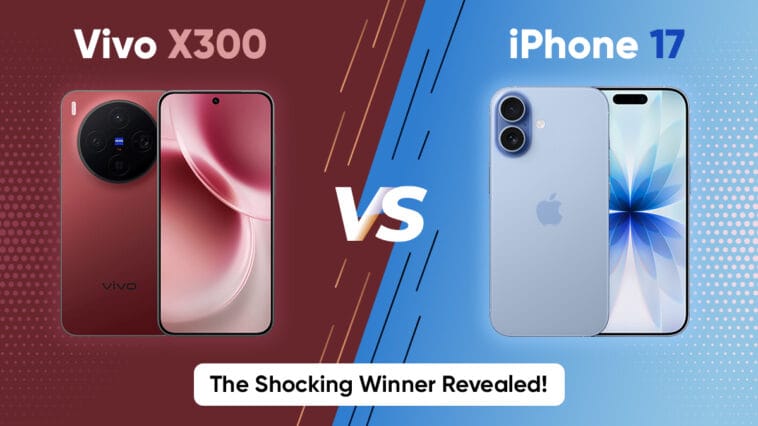
Choosing between the Vivo X300 and the iPhone 17 looks simple until you dig into the details. One is Apple’s polished, predictable flagship. The other is a spec-heavy Android beast pushing hardware limits. Here’s the twist: once you compare, Vivo X300 vs iPhone 17, what actually matters in daily use, one of these phones pulls ahead in ways you probably didn’t expect.
Vivo X300 vs iPhone 17: Comparison
Feature | Vivo X300 | Apple iPhone 17 |
Display | 6.31″ LTPO AMOLED, 120Hz, 4,500 nits peak | 6.3″ LTPO Super Retina XDR OLED, 120Hz, 3,000 nits peak |
Chipset | MediaTek Dimensity 9500 (3nm) | Apple A19 (3nm) |
RAM / Storage | Up to 16GB / up to 512GB, UFS 4.1 | 8GB / up to 512GB, NVMe |
Main Camera | 200MP, f/1.68,PDAF, OIS | 48MP, f/1.6, PDAF, Sensor-shift OIS |
Telephoto | 50MP,f/2.57, 3x periscope, PDAF, OIS | Not Available |
Ultrawide | 50MP, f/2.0, AF | 48MP, PDAF |
Front Camera | 50MP, f/2.0 AF | 18MP, OIS, AF |
Battery | 6,040mAh | 3,692mAh |
Wired Charging | 90W | 40W (AVS required for full speed) |
Wireless Charging | 40W | 25W MagSafe / Qi2 |
OS | OriginOS 6 (Android 16), 5 major updates | iOS 26 |
IP Rating | IP68 + IP69 | IP68 (up to 6m) |
Weight | 190g | 177g |
Price (starting in INR) | ₹75,999 | ₹78,900 |
Design and Build Quality
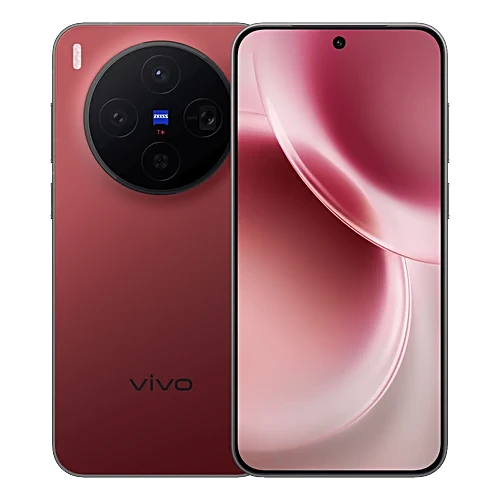
The Vivo X300 looks and feels like a premium device that means business. It sports a glass front, aluminum alloy frame, and a glass back, all wrapped in a slim 8.0mm profile. At 190g, it has a satisfying heft without feeling uncomfortable. The Summit Red colorway in particular turns heads — that deep, velvety matte finish is one of the best-looking backs on any phone this year. The camera module sits flush with the back panel, leaving no gaps for dust or grime to collect. Even better, the X300 carries both IP68 and IP69 ratings, meaning it can handle not just a swim but high-pressure water jets as well — making it the tougher phone for outdoor use.
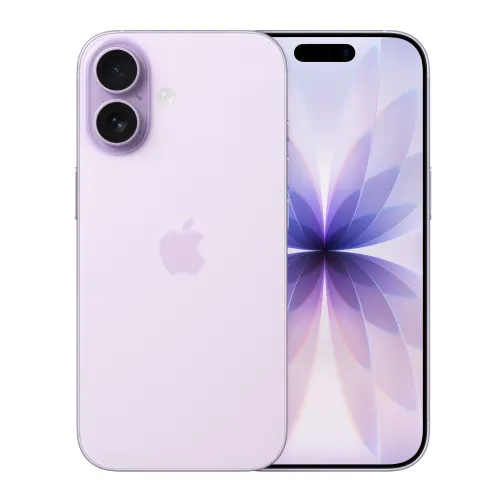
The iPhone 17, by contrast, is lighter at 177g and keeps Apple’s familiar clean aesthetic. The all-glass rear with an aluminum frame looks polished, and the thinner bezels this year make the front look noticeably more premium than the iPhone 16. Apple’s Ceramic Shield 2 on the front is also a genuine upgrade for drop protection. Still, the iPhone 17 has only IP68 (no IP69), and the design is largely unchanged from its predecessor.
Here’s what matters: you’re trading elegance for toughness. If you care about durability and grip confidence, Vivo quietly wins this round.
Display
Both phones feature 120Hz LTPO panels for smooth scrolling, but key differences lie in brightness, HDR support, and overall display impact.
The iPhone 17 offers superb OLED quality, with excellent HDR performance and a peak brightness of around 3000 nits. It’s reliable, color-accurate, and consistent. In outdoor conditions, we measured the iPhone’s brightness at 1000 nits. The display supports HDR 10 and Dolby Vision formats.
The Vivo X300 pushes things further with an LTPO AMOLED panel and extreme peak brightness levels that can reach around 4500 nits. We measured Vivo’s X300 display to 2000 nits in outdoor conditions. However, Vivo only supports HDR 10 and HDR 10+ formats.
What this means for you:
- Outdoor visibility is better on Vivo X300
- HDR content looks more dramatic on Vivo X300
- Color accuracy is better in iPhone 17
In real-world use, Vivo feels more vibrant and modern. The difference isn’t huge indoors, but outside, it’s obvious.
Battery Life, Charging Speed, Speakers
This is where the gap becomes impossible to ignore.
The iPhone 17 has a 3692mAh battery. It’s efficient thanks to iOS optimization, but still lands in average territory.
The Vivo X300 packs a massive 6000mAh+ battery. That’s not just bigger on paper. It translates into significantly longer screen time, especially for gaming and video.
Charging tells the same story:
- Vivo: 90W wired, 40W wireless
- iPhone: 40W wired, 25W wireless
What this really means:
You plug in Vivo for 50 minutes, and you’re done. The iPhone still requires patience here; 0 to 100 takes 1 hour and 30 minutes.
For speakers, both phones use stereo setups. The Vivo X300 gets the job done with dual stereos, though reviewers noted the audio can muffle dialogue at high volumes and the sound separation isn’t ideal. The iPhone 17’s speakers are renowned for producing clean and well-balanced audio. Neither is perfect, but the iPhone edges ahead in audio quality.
Still, battery + charging alone is a knockout win for Vivo.
Software and Performance
Apple still leads in raw chip efficiency. The A19 is incredibly optimized, and iOS runs smoothly with fewer hiccups.
Synthetic Benchmark (iPhone 17) | Score |
GeekBench (Single-core) | 3620 |
GeekBench (Multi-core) | 9310 |
Antutu 10 | 2109553 |
But here’s the interesting part: performance differences are now minimal in daily use. Both phones handle gaming, multitasking, and heavy apps effortlessly.
Where Vivo flips the script:
- More RAM (12GB–16GB vs 8GB)
- Better multitasking freedom
- More customization
Synthetic Benchmark (Vivo X300) | Score |
GeekBench (Single-core) | 3416 |
GeekBench (Multi-core) | 9741 |
Antutu 10 | 2346112 |
Android 16 with OriginOS gives you flexibility that iOS simply doesn’t. You can tweak, customize, and control your phone in ways Apple still restricts.
So what matters more to you?
- Smooth + simplicity + polished UI → iPhone
- AI + Features + freedom → Vivo
For most power users, Vivo feels less limiting.
Camera, Photo and Video Quality
This is the most debated category.
This is the headline feature that makes the Vivo X300 a genuinely special phone. Its triple-camera setup consists of a 200MP main shooter (f/1.68, 1/1.4″ sensor with OIS), a 50MP 3x periscope telephoto, and a 50MP autofocus ultrawide. The front camera is also a 50MP unit with autofocus. The periscope telephoto alone is a major differentiator — it lets you zoom in with real optical clarity at 3x, and the 200MP main sensor captures incredible detail. The X300 also supports 4K@120fps HDR video recording and 4K60 Portrait Cinematic mode.
The iPhone 17 brings a dual-camera system: a 48MP main (f/1.6) and a 48MP ultrawide with autofocus. There is no dedicated telephoto. The main camera photos offer very good quality overall with plentiful detail, accurate colors, and good contrast, but noted limited dynamic range with crushed shadows and clipped highlights at times. Apple’s portrait mode and video stabilization remain best-in-class. The iPhone 17 delivers excellent video quality and stabilization across all cameras, with Dolby Vision up to 4K60 — something Apple has always done better than anyone. The 18MP selfie with OIS is also outstanding.
Still, the lack of a telephoto lens on the iPhone 17 is a serious limitation. The Vivo X300 gives you a true 3x optical zoom, a much larger main sensor, a higher-resolution ultrawide with autofocus, and a sharper selfie cam. For photo versatility and outright image resolution, the X300 wins decisively. iPhone 17 has the better video ecosystem.
Let’s break it down:
- Daylight photos → Vivo wins on detail
- Zoom → Vivo dominates
- Night → Vivo stronger
- Video → iPhone still ahead
If you shoot photos more than videos, Vivo clearly pulls ahead.
Verdict
If you walked in expecting the iPhone 17 to hold its ground, the numbers tell a different story. The Vivo X300 scores higher across nearly every hardware category: it has a brighter display, a far larger battery, dramatically faster charging (and includes the charger), a triple-camera setup with actual telephoto zoom, and a fully modern Android 16 software experience. The iPhone 17 fights back with a lighter body, class-leading video stabilization, the MagSafe ecosystem, and speakers that sound slightly better. It’s also the safer choice if you’re already deep in the Apple ecosystem. But in a straight hardware and value comparison, the Vivo X300 is the stronger phone — and by a wider margin than you might expect.
Pros and Cons
Vivo X300
PROS | CONS |
|
|
Apple iPhone 17
PROS | CONS |
|
|
Which One Should You Buy?
The choice between the Vivo X300 vs iPhone 17 comes down to your priorities. The iPhone 17 offers a smooth, reliable experience with strong video recording and seamless integration within Apple’s ecosystem. It’s ideal if you value simplicity and long-term software support. However, the Vivo X300 delivers more overall value with a larger battery, faster charging, brighter display, and a more versatile camera system featuring a 200MP sensor and optical zoom.
In everyday use, both phones perform at a flagship level, but Vivo stands out for power users, gamers, and photography enthusiasts who want flexibility and longer battery life.
If you prefer ease of use, go with the iPhone. But for most people, the Vivo X300 is the smarter buy because it offers more features and fewer limitations at the same level.
Read more:
Vivo T3 Ultra and Vivo V40: Which Vivo Reigns Supreme?
Which Pocket-Sized Powerhouse Wins? OnePlus 13s or Vivo X200 FE?


Comments
Loading…